Genome editing could transform how Europe breeds healthier, more resilient farm animals. But how close are we, really? EuroFAANG spent a year asking scientists, breeders, and regulators exactly that — and the answers reveal a technology standing right at the edge of what’s possible.
Where the findings came from:
- A World Café workshop at the FABRE-TP AGM in Brussels (May 2023) — 40 stakeholders split across breeding, academia, and industry
- The first EuroFAANG “think-tank” meeting on genome editing (October 2023) — 43 experts, one virtual room
- Cross-checked against the latest scientific literature and policy reports
The barriers standing in the way:
- We simply don’t know enough about genome function — there aren’t many confirmed editing targets yet
- Predicting what an edit will actually do in a live animal is still guesswork in many cases
- Regulations and public attitudes swing wildly from one country to the next
- Off-target effects remain a real, unresolved technical risk
- Most valuable traits (disease resistance, feed efficiency) are polygenic — meaning single-gene edits won’t cut it; multiplex editing is needed but still immature
- Mosaicism in edited founder animals complicates things further
- Breeding programmes are expensive and hard to replicate, making it tough to slot edited animals in
- Current editing methods (embryo transfer, laparoscopic surgery) aren’t scalable “on farm”
- The CRISPR licensing landscape is a legal maze — commercial use requires fees academic research doesn’t
- Nobody’s even agreed on solid definitions for “genome editing,” “GMO,” or “animal welfare”
- Then there’s traceability: once an edited animal breeds, how do you track its edited descendants through the food chain?
The upside that makes it worth solving:
- Real disease resistance — already achieved for PRRS virus in pigs and avian influenza in chickens
- “Surrogate sire” strategies that spread edited genetics without any edited animal ever entering the food chain
- Faster breeding progress on traits that are otherwise nearly impossible to select for
- In vitro systems (organoids, cell lines) that let scientists safely test edits before touching a live animal
- A genuine tool for climate adaptation — tackling methane emissions and future pandemic threats
- High-throughput CRISPR screens already yielding results for diseases like African Swine Fever
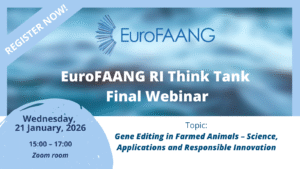
The nuance that changes everything: the report suggests edits that mimic naturally occurring genetic variation may be viewed far more favourably — by both regulators and the public — than edits that create entirely new (de novo) genetic combinations. That distinction could shape the entire regulatory future of the technology, and it’s exactly what the final think-tank webinar (January 2026) dug into.
Bottom line: genome editing, paired with well-managed breeding programmes, could genuinely improve animal health, productivity, and welfare across Europe — but only if the science, the regulation, and public trust move forward together.