Farmed animal science has a gap that nobody else is filling. Genomics has raced ahead. Phenotyping technology has raced ahead. But the connective tissue between the two — the genotype-to-phenotype (G2P) research that turns genetic data into real, usable knowledge about health, welfare, and sustainability — has stayed fragmented, scattered across national labs, one-off projects, and disconnected infrastructures.
That gap is exactly what the 2021 ESFRI Roadmap flagged as missing at the pan-European level. It’s exactly what EuroFAANG was built to close.
EuroFAANG — A European infrastructure for farmed animal genotype to phenotype research — brings together seven partner institutions across Europe (FBN, INRAE, Wageningen University, EMBL, EFFAB, NMBU, and the University of Edinburgh) to design a shared infrastructure for G2P research in terrestrial and aquatic farmed animals. It builds directly on five completed H2020 projects — AQUA-FAANG, BovReg, GENE-SWitCH, GEroNIMO, and RUMIGEN — and connects them into something more durable: a European research infrastructure that outlives any single project.
But an infrastructure is only useful if people can actually find their way into it. That’s why EuroFAANG’s work is organised around three hubs — each one a front door into a different, essential piece of the puzzle.
Gene Editing Hub: Making a Powerful Tool Trustworthy
Genome editing could transform farmed animal breeding — real disease resistance, faster genetic progress on traits that are otherwise nearly impossible to select for, better welfare outcomes. Some of this isn’t hypothetical: disease resistance to PRRS virus in pigs and avian influenza in poultry has already been demonstrated in research context.
But a powerful tool without trust doesn’t get used. That’s the real barrier here — not the science, but the regulatory uncertainty, the patchwork of public attitudes across countries, and the basic lack of agreement on what terms like “genome editing” and “GMO” even mean in this context.
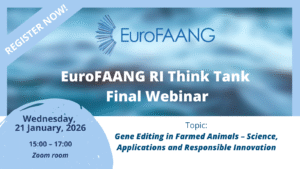
The Gene Editing Hub exists to work on exactly that problem. It’s home to EuroFAANG’s Genome Editing Think Tank — a closed-door, NDA-protected space where over 50 experts from breeding companies, academia, and research centres across Europe (and beyond — Canada, the US, Kenya) have been meeting since 2023 to work through the barriers and opportunities honestly. It’s also home to a growing directory of the labs across Europe actually doing this work, and the final outputs of that process: a January 2026 closing webinar and report making the case that the future of gene editing in European farmed animals depends less on new technical breakthroughs and more on regulatory evolution, shared infrastructure, and sustained public engagement.
In Vitro Hub: The Infrastructure Behind the Infrastructure
Every G2P breakthrough needs somewhere to happen before it reaches a live animal. That’s what the In Vitro Hub is for.
This hub brings together two things that belong together but rarely get talked about in the same breath: the physical infrastructure of biobanking — shared repositories of tissues, cells, and genome-edited cell lines, standardised protocols, and an “open samples” policy built to let researchers and industry share resources equitably — and the ELIXIR Domestic Animals Genome and Phenome Community, a growing network established in December 2025 to build the standards and shared models that G2P research actually depends on.
Put simply: this is where the 3Rs principle — replacing, reducing, and refining the use of live animals in research — stops being an aspiration and starts being infrastructure. Organoids, cell lines, and standardised in vitro systems mean researchers can test causal genetic variants safely, before anything reaches a live animal, and do it using shared, comparable methods instead of reinventing the wheel at every institution.
Emerging Species Hub: Filling In the Map
Ask most people to name a farmed species and they’ll say cattle, pigs, chickens. But Europe’s food system increasingly depends on species that don’t fit that picture: insects for protein and feed, marine invertebrates, under-studied fish, and livestock breeds that never made it into the mainstream research pipeline.
These species matter for exactly the reasons the mainstream ones already have decades of infrastructure behind them — genetic diversity, disease resistance, sustainability, circular-economy farming. But G2P research on them is scattered and hard to find, which means duplicated effort, missed collaborations, and slower progress than there needs to be.
The Emerging Species Hub is EuroFAANG’s answer: an interactive map of the INSECT IMP project’s researchers working specifically on farmed insect species, sitting alongside a growing directory of institutions working on everything else — marine invertebrates, finfish, poultry, bees, and livestock breeds that fall outside the conventional research infrastructure. It’s a first, curated snapshot rather than a finished map — and it’s built to grow as more researchers get in touch.
Three Hubs, One Infrastructure
None of these three hubs work in isolation — that’s the point. A genome edit validated in an in vitro model, tested for safety and public trust through the Gene Editing Think Tank, applied to a species that’s only just entering the research mainstream — that’s the actual pathway EuroFAANG is building toward. Genotype to phenotype, across every species that needs it, backed by infrastructure that’s actually easy to find and use.
That’s what these three hubs are for. Not three separate projects, but three doors into the same idea: that farmed animal science in Europe deserves an infrastructure as connected as the science itself.
Want to get involved? Each hub is actively looking for input — from universities , research center working on farmed animal breeding and genetics to labs working on genome editing, to researchers with in vitro models to share, to anyone working on an emerging species who isn’t on our map yet. Get in touch!