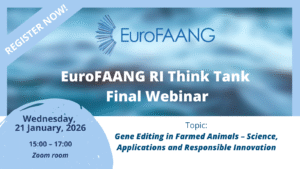
In October 2023, EuroFAANG did something that had never quite been done before: it got scientists, ethicists, regulators, and industry leaders from across three continents into the same virtual room to talk honestly about genome editing in farm animals — no PR spin, just an NDA and an open mic.
The turnout tells its own story:
- 100 experts invited → 63 said yes → 52 showed up
- Mostly European, with voices from Canada, the US, and Kenya
- A genuine cross-section of the field: 41% breeding companies/associations, 37% academia, 22% research centres
- Expertise spanning ethics, policy, welfare science, breeding, regulation, and gene-editing tech itself
What they found: a technology full of promise — and just as full of friction.
The barriers nobody’s solved yet:
- We still can’t reliably predict what an edit will do once it’s in a live animal
- Off-target effects remain a real technical risk
- Every country (sometimes every region) sees the ethics and regulation differently
- The legal language around “genome editing” is still a moving target
- Farming already carries public trust baggage — this doesn’t help
- The traceability problem: once an edited animal breeds, how do you track its edited descendants?
The upside that’s driving the whole effort:
- Disease-resistant animals — real defenses against threats like avian flu and African swine fever
- Faster genetic progress in breeding programs
- Better science: improved in vitro models (cell & tissue cultures) to test edits before they ever reach a live animal
- A genuine lever for climate adaptation and more sustainable food systems
Where the group thinks energy should go next:
- Talking to consumers — not just regulators
- Educating the entire food chain, not just the labs
- More testing of genomic variants before wider rollout
- Building the technical muscle to actually scale this safely
The most telling outcome? Even this room full of experts couldn’t fully agree on terminology — so they formed a volunteer subgroup just to nail down shared definitions. That’s how early-stage this field still is, and how much is riding on getting the framework right.